

May 12
9 min read
PHOTOFILE | A CONVERSATION WITH
ARCHIVING EDEN
A CONVERSATION WITH DORNITH DOHERTY
BY LUCY J. ROGERS
Dornith Doherty is an American artist working primarily with photography, video, animations, works on paper, and scientific imaging. Her practice concentrates on ecological and philosophical issues and is often made in collaboration with scientists, archives, botanical centers, and research institutes. In 2008, Doherty began an extensive project documenting national seed banks, leading her to visit and work with botanical collections across 5 continents. Titled Archiving Eden (2008–ongoing), the project examines the role of seed banks as essential botanical backup systems in a world facing global climate change, habitat loss and decreased biodiversity.
In this interview, Doherty discusses the motivation behind Archiving Eden (2008–ongoing) and how she aims to make artworks which inspire conversations around, and support for, the protection of the natural world.

Archiving Eden (2008–) is an extensive project, made in collaboration with scientists and seed banks from all over the world. How did it first develop?
In 2008, I read an article in the New Yorker magazine about the pending completion of the Svalbard Global Seed Vault in “Sowing for Apocalypse: The Quest for a Global Seed Bank” by John Seabrook. I was moved by the tension between the optimistic character of the collaboration between multiple stakeholders (governments, volunteers, and scientists) to create a botanical back-up system, and the gravity and complexity of the problems like climate change and political instability that created the need for a remote and secure vault near the North Pole.
I was compelled by the importance and urgency of creating a global seed bank to ensure the survival of genetic diversity, plant life, and through those efforts, possibly humanity itself. I immediately wanted to photograph it. It took me two years to receive an invitation to do so.
Getting permission to visit these sites must have been difficult. How did you gain access?
I started Archiving Eden by photographing at the Ladybird Johnson Wildflower Center, outside of Austin, Texas. While I was there, the Center was collecting wild land flora in West Texas. Some of these seeds were to stay at the centre but further collections were being put together for the US seed bank and for shipment to Svalbard.
Then I met a researcher who connected me to the US bank (the National Laboratory for Genetic Resources Preservation) in Fort Collins, Colorado. I made several trips to Fort Collins and established a working relationship with Dr. Dave Ellis, a curator and plant physiologist at the seed bank. He introduced me to Cary Fowler, the founder of the Svalbard Global Seed Vault who invited me to photograph the vault in 2010. The vault is only open a couple of days a year, when they deliver new seed accessions to the vault, so it was a huge honor to be invited.

What was it like first going inside the Svalbard Seed Vault [1]?
When I finally arrived at Svalbard, stepping into the seed vault took my breath away. Bitterly cold and filled with the sound of forced air rushing through the shelves, I was surrounded by fertile and diverse seeds resting in a state of suspended animation, preserved for a distant and unknowable future. If you think about it, it’s one of the most biodiverse places on Earth. The moment was profoundly moving. Svalbard is also a site which has strictly controlled access. Each country owns their own seed patrimony; therefore, the safety of the seeds kept at Svalbard must be guaranteed. It took a long time to establish that trust between countries. It really was a big deal, to be able to go inside the vault and photograph the seeds in situ.
Svalbard is often described as a “doomsday vault”, as it was built to ensure, like you say, against future global catastrophe, including the threat of nuclear war. Yet your work feels optimistic. Is that a fair interpretation?
Yes, for me, Svalbard has an optimistic aspect in that despite the fact we have brought ourselves to the brink of irretrievable collapse, there are people who are doing their very best to preserve botanical life, with the hope that species could be saved, rescued or revived.
The idea of Svalbard is that it would be so far north that if the electricity went out or if the worst happened, the permafrost would keep it cold for 200 years. It’s position on a mountain is also to ensure against flooding as the permafrost melts.
The whole project is part of ongoing research. Each seed has its own specific requirement. The idea is to freeze it, place it at a stable temperature and keep it from germinating but with some seeds, this is very difficult to do. In this sense, we are trying to extend life at different scales by placing them into stasis.
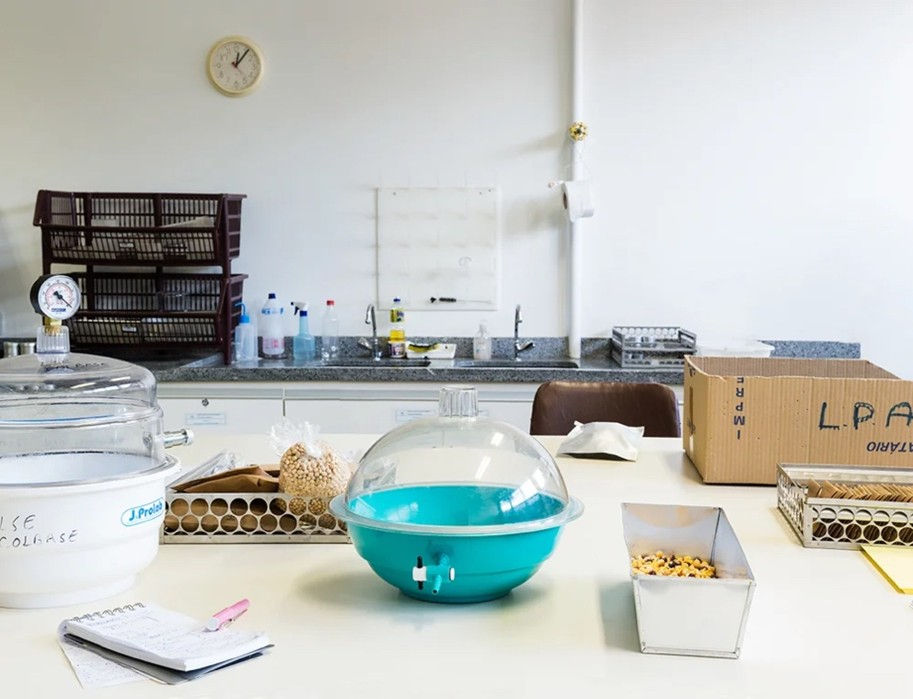
Archiving Eden is made up of multiple parts. In ‘The Vaults’, you focus on the architecture of the space, as well as the equipment, scientific apparatus and logistics of seed storage. Looking at these photographs, I’m struck by the contrast between the seeds as organic “material” and the artificial environment they are stored in. When you were making these photographs, were you aware of this contrast?
Yes, I have always been struck by the contrast between the tiny seeds and the extensive technological infrastructure that has been built to store them. The banks try to future-proof the archives as much as they can to safeguard the collections from natural disaster or other calamities. It makes me think about time from a different perspective, since the seed banks are trying to extend the life of seeds for two hundred years or more.
This contrast is one of the reasons I started using x-ray imaging of the seeds. The seeds may be tiny, delicate objects, but they are also resilient, with the ability to preserve the spark of life for centuries.
![Dornith Doherty, Seedling Cabinet I, I, III [digital chromogenic lenticular prints, digital collages made from x-rays captured at the National Center for Genetic Resources Preservation (USA) and the Millennium Seed Bank (England)], from the series ‘Archiving Eden’ (2008–ongoing). © Dornith Doherty. Courtesy of the artist.](https://static.wixstatic.com/media/ec246a_ca058193e28942bcad705d7469c8be22~mv2.jpg/v1/fill/w_980,h_469,al_c,q_85,usm_0.66_1.00_0.01,enc_avif,quality_auto/ec246a_ca058193e28942bcad705d7469c8be22~mv2.jpg)
Could you tell me more about the process of making these digital collages using the seeds themselves. When did you first start working with x-ray machines?
I started working with x-ray imagery very early in the project. I photographed a room where they were using the x-ray machine to review sample seeds for damage. I was inspired by the extraordinary visual power of x-rays that allows you to see things that are invisible to human vision. For me, the documentary images of the spaces and technological interventions required to store the seeds in a state of suspended animation are metaphoric, and have the ability to provoke questions and suggest connections to different aspects of philosophical, political, and social concerns that are embedded in the very act of seed-banking. However, sometimes those connections are overlooked. The x-ray images, while maintaining the sharpness and detail of the other photographs, invite a certain slippage between what is shown in the image and what the image is about. They more openly suggest layers of meaning beyond being an illustration or explanation. I love how the two sides of the project are in conversation.
I should also mention that I was able to use this expensive research equipment through the collaboration of Dr. Dave Ellis. He allowed me to use the machine and also grew research plantlets for me to image. They had not used the machine on plants before that time.
Many of the x-rayed seeds appear to be gently moving in what you have previously described as a ‘state of suspended animation’. They appear somehow “charged” with a latent potential for (re)growth.
When I look at the seeds, I am looking at the beginning of life. In a few of the collages, the seeds may appear to burst forth. The collages made from the x-rays, which vary from aggregates of monumental numbers of seeds such as 1,400 Ash Tree Seeds to individual plantlets such as Pea are a way for me to consider questions I have about the role of humans and science in relation to gene banking. The seeds may be still, but they are very much alive, and the seed banks are filled with these life forms.
Some of these collages look like cyanotypes, one of the oldest photographic processes but also one which has historically been used for botany and scientific illustration. They make me think about the early work of Anna Atkins [2].
Yes, I love Anna Atkin’s groundbreaking work. Cyanotypes are wonderful because of their indexical quality. I love the sharpness of detail and the direct connection between the original plant and the print.
I have been thinking about the color blue as a way of adding another layer of meaning. I use delft or indigo blue in the x-ray collages because it references not only the process of cryogenic preservation I mentioned before, but also the massive exchange of plants, diseases, technologies, cultures, and people that started with the Columbian exchange [3]. Blue is a way for me to refer to the complex (and not always benign) history of plant collecting and study, and the intersection of east and west, trade, and cultural and scientific exchange.
I’ve also made a few lenticular prints [4]. These prints are made from x-rays of research seedlings, and they shimmer from green to blue as viewers move past them. This tension between stillness of the print and the movement of the color reflects my focus on the elusive goal of stopping time in living materials.
![Dornith Doherty, Corn Seedlings, [Digital Chromogenic Lenticular Photograph], from the series ‘Archiving Eden’ (2008–ongoing). © Dornith Doherty. Courtesy of the artist.](https://static.wixstatic.com/media/ec246a_10bb4c89fa884c208167ed8cb88bfd18~mv2.jpg/v1/fill/w_432,h_211,al_c,q_80,enc_avif,quality_auto/ec246a_10bb4c89fa884c208167ed8cb88bfd18~mv2.jpg)
Your approach often goes beyond the purely “photographic”, creating images which are formed of multiple, overlapping layers. This is true of the digital collages in Archiving Eden but is also a strategy used in your other works in different ways.
This is something I think about a lot. I can only speak for myself. What I’m interested in is making original work that connects to really important issues like environmental justice in a poetic and subjective way. Only one person can enter some of these spaces, yet photography can expand knowledge by inviting others also to “see” inside. It brings people closer to what might otherwise seem distant. In this sense, photography acts as a “trusted witness” (in a Szarkowskian kind of way)[5]. It’s like reading a novel – you have an intimate, one-on-one experience with a work of art, and maybe the work makes you think about things in a way you hadn’t considered before. Making work that has a photographic origin is important to me, and the layering expands the potential for meaning and beauty.
Bibliography
Atkins, Anna. Photographs of British Algae: Cyanotype Impressions, 1848–49.
Doherty, Dornith. Archiving Eden. Schilt, 2017.
Pollan, Michael. The Botany of Desire. Random House, 2001.
Seabrook, John. “Sowing for Apocalypse”. New Yorker, 2007. https://www.newyorker.com/magazine/2007/08/27/sowing-for-apocalypse
Szarkowski, John. The Photographer’s Eye. Museum of Modern Art, 1966.
[1] The Svalbard Global Seed Vault, otherwise known as “the Vault”, is the largest secure seed storage facility in the world. It is located in the Arctic permafrost in the northern most region of Norway.
[2] Anna Atkins (1977–1871) was an English botanist and photographer. She is often considered the first person to publish a book illustrated with photographic images.
[3] The Columbian exchange (named after Christopher Columbus) was the result of European colonization and global trade, which led to the widespread transfer of plants, animals and diseases between the Americas and Afro-Eurasia in the late 15th century.
[4] Lenticular prints use the overlay of more than one image to create the appearance of a 3D image or animated movement.
[5] In The Photographer’s Eye writer and curator John Szarkowski describes the role of the photographer as a “witness” to time.
How to cite
Rogers, Lucy J. ‘ARCHIVING EDEN: A Conversation with Dornith Doherty.’ Archivo Photofile, 12 May 2026. https://doi.org/10.5281/zenodo.20140146 .
About the author


